
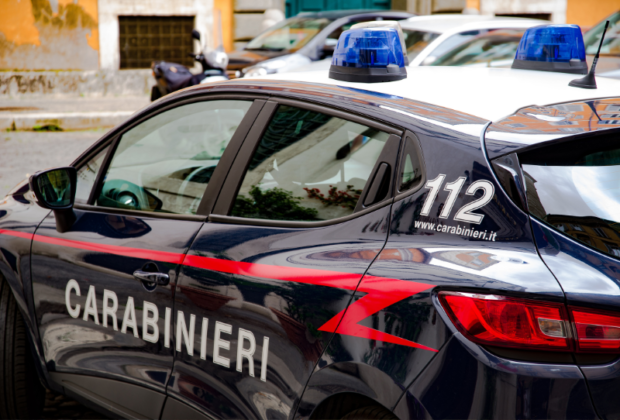
The Carabinieri were founded in Turin during the time known as the Restoration as a military corps with special police functions. Since then, the Carabinieri, in their iconic uniforms, have been a constant point of reference for us Italians. In Italian culture, the Carabinieri represent an important moral model and enjoy great affection because they are always available to listen to and help citizens. In fact, the Carabinieri often feature as the butt of numerous jokes and in television series.
A little bit of history
The Royal Carabinieri Corps was established by Victor Emanuel I of Savoy in 1814, after he returned to Turin following the end of Napoleon’s occupation. The first enlisted personnel were selected from the most excellent elements of the Piedmontese army units and their first general was Giuseppe Thaon di Revel. During the Risorgimento, the Carabinieri played an important role to bring about the Unification of Italy, fighting on several fronts. In 1861, they became the Corps of the Royal Army.
Until the year 2000, the Carabinieri were an integral part of the Italian Army, but since 31 March 2000 they have become an autonomous armed force (i.e. an organisation of soldiers trained and equipped to fight) which, like the Navy or the Air Force, answers directly to the Ministry of Defence. The Carabinieri, therefore, have a dual role that sees them involved in both military and police tasks.
Curious about places to see in Turin? Check out this post!
So, what’s the difference?
In addition to their important role in maintaining public order, which includes traffic police tasks, and in civil protection interventions in the event of natural disasters, the Carabinieri collaborate with the other armed forces in the defence of the Italian territory. They are also responsible for the security of the President of the Republic and the Italian diplomatic and consular representations abroad. The Carabinieri are often involved in international peace-keeping missionsand as military police.
The Carabinieri differ from the State Police in that the latter is an institutional organisation which, although it has the task of guaranteeing public safety and public order, is controlled by the Ministry of the Interior.
The State Police, moreover, has a more centralised organisation in Rome, while the Carabinieri have a more decentralised organisation with peripheral commands in all Italian provinces. The two institutions have different responsibilities: the State Police is responsible for the prevention of and fight against crime in cities and often also carries out administrative tasks (such as, for example, issuing passports), while the Carabinieri act mainly in rural areas and in the context of the protection of public order. Despite these differences, the Police and the Carabinieri work closely together to ensure public safety throughout Italy.
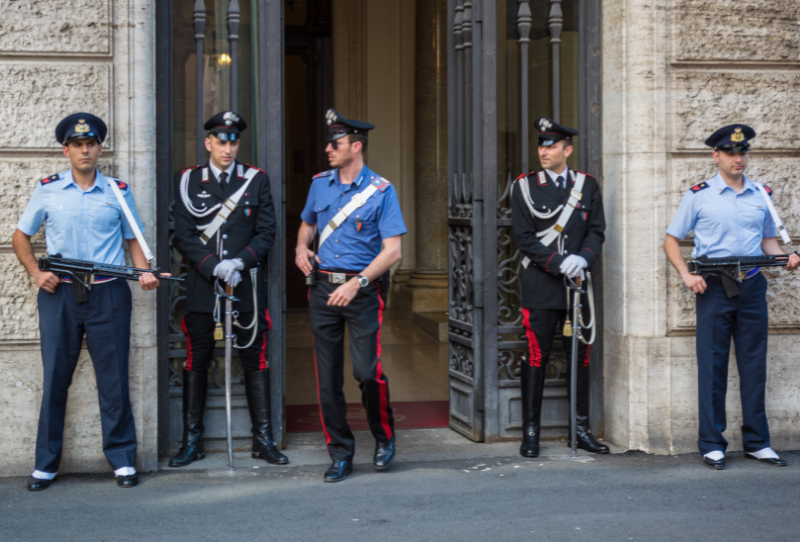
The ordinary uniform of the Carabinieri is black: it consists of a jacket with four silver buttons decorated with a flame and worn over a white shirt and a black tie. On the lapel of their jackets, the officers of the Carabinieri do not wear the insignia (badges applied to the collar or sleeves of uniforms to distinguish different units or corps), but the so-called frogs (i.e. ornaments embroidered in silver or white cotton) with acanthus leaves showing leaves (the so-called palma), stem (the branca) and the terminal tuft with flowers (the nappo). Furthermore, officers, their deputies and sergeant majors do not wear a vertical red band on their trousers. Sargeant majors (but not their deputies) and chief brigadiers in the armed services wear the so-called Sam Browne, a belt with a shoulder strap from which hangs a leather holster, a container for their handguns. The other officers wear the bandoliera, a striped belt worn over their shoulder and hanging from one shoulder to the opposite hip. Officers and inspectors, if they are not on armed duty, carry their weapons under the flaps of their jackets.
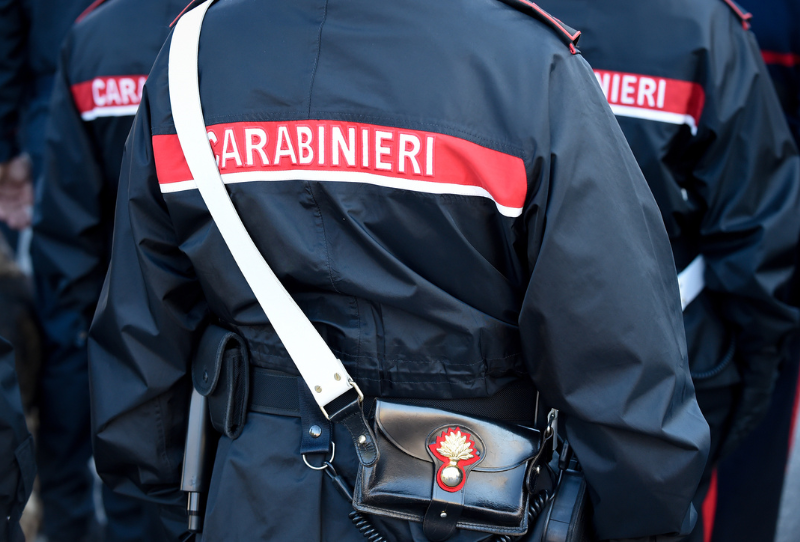
The Carabinieri also wear a cap with the frieze of the Carabinieri. This shows is a grenade surmounted by a flame with thirteen tips, bent by the wind and with the monogram R.I. (which means Italian Republic). The frieze recalls the concepts of loyalty, fidelity and highest honour.
The Carabinieri Corps is celebrated on 5 June in memory of the first Gold Medal for Military Valour awarded for their participation in the First World War, while the patron saint is the Virgo Fidelis, that is the Virgin Mary Mother of Jesus, to whom a special prayer is dedicated and recited in solemn military ceremonies featuring the Corps or their members, and which is connected to the heraldic motto of the Carabinieri: "Faithful over the centuries".
How do you become carabinieri?
To become a carabiniere, there is a set of public examinations reserved for individuals already in the ranks of the Italian armed forces, or who have in any case served a period of time in the Italian armed forces. In some cases, especially for sportsmen and women and musicians, the direct enlistment of civilians is allowed. The tests are held in Rome at the National Selection and Recruitment Centre. Depending on their role, winners are sent to the various training facilities; as far as inspectors and officers are concerned, recruitment takes place through public examinations open to both civilians and soldiers, or through internal selections open exclusively to military personnel in possession of certain requisites.
Discover Turin's ice cream heritage!
An important training school for the Carabinieri is located in Turin, inside the historic Cernaia Barracks, where there is also an interesting museum that can be visited on very special occasions. Inside the Cernaia Barracks there is also the National Monument to the Carabinieri erected in 1933 to honour the sacrifice of those fallen during the First World War.
In Rome, not far the Vatican, there is the Historical Museum of the Carabinieri which collects documents, photographs, historical weapons and period uniforms, as well as works of art from the nineteenth and twentieth centuries, which depict the image of the Carabinieri.
A special mention goes to the Musical Band of the Carabinieri which is known all over the world for its stylistic perfection, the variety of its repertoire and their beautiful uniforms.
Want to learn more about Italian culture and study Italian in Italy? Check out our school in Turin!

Scuola Leonardo da Vinci Turin
The welcoming friendly atmosphere of our school will make you feel at home and you can relax with your classmates in the small gardens of the adjacent pedestrian area.
Latest posts by Scuola Leonardo da Vinci Turin (see all)
- The Countess of Castiglione, the first ever influencer! - March 12, 2026
- ITALIAN COURSE & CHOCOLATE? CIOCCOLATO’ IN TURIN from 13 to 22 February 2026 - February 13, 2026
- Do you know the Turin specialities MoleCola and M**Bun? Come to Turin to try them! - January 22, 2026