
Summer is the perfect time to enjoy an ice cream under the Turin’s arcades, which stretch for 18 kilometres and give the city a demure charm and timeless elegance. Enjoying an ice cream in Turin goes far beyond its flavour: it is a ritual, a sensory experience rich in history and tradition.
The Turin tradition of ice cream is closely linked to the city's Historic Cafés, which have played a fundamental role in building Turin’s social and cultural identity. In the 30s, Caffè Fiorio was the first in Italy to serve ice cream on a cone as we know it today. From then on, people began to walk around while having their ice-cream. Until then, in fact, ice cream was only eaten sitting down, with a spoon, inside what were them called cremerie.

This novelty was both a small scandal and a great success: Turin was the seat of the Royal Court and social customs were dictated by rather rigid behavioural rituals. Seeing refined ladies walking down the street licking an ice cream was considered bold, almost vulgar, certainly outside any acceptable etiquette. Beyond moral judgment, there was also a practical risk: the ice cream melted quickly and could stain the elegant dresses of the ladies.
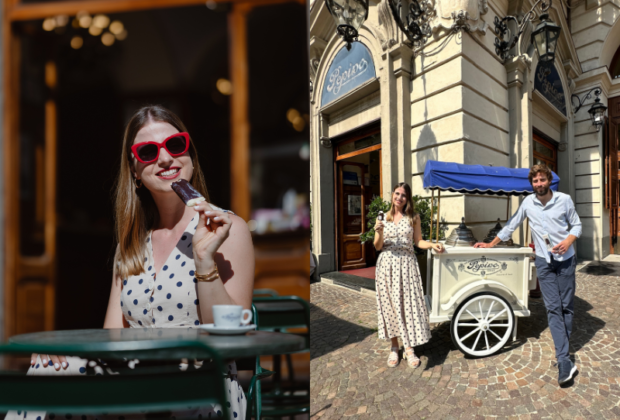
Precisely to make the experience of ice cream on the go a bit more dignified, the Gelateria Pepino — founded in 1884 by the Neapolitan Domenico Pepino who landed in Turin in search of fortune and became, over time, the official supplier of the House of Savoy and, therefore, a symbol of elegance and tradition — brought further innovation in their artisan production. The ice cream was served on a stick and was covered in chocolate so as to melt more slowly.
So, in 1938, the Pinguino, the first ice cream on a stick covered with chocolate in the world, was born. The invention was patented and quickly spread through the city and then all over the world. The match between ice cream and chocolate was made possible thanks to the resourcefulness of the Cavagnino-Feletti family, who had bought the ice cream parlour when Domenico Pepino decided to retire and return to Naples. The Cavagnino family, which still owns the Pepino ice cream parlour - the only case among the city’s Historic Cafés - was in fact also the owner of the historic Feletti chocolate factory.


From a simply functional solution, therefore, the Penguin established itself as a new way of experiencing ice cream. We can consider it an almost revolutionary dessert, as it transformed the ritual of ice cream into something lighter, freer and deliciously modern.
Although initially the “ice cream on-the-go”, that is the one to be enjoyed while walking, was quite expensive, it was still more affordable than the traditional sitting-down version in a cremeria. Over time, this way of eating ice-cream became increasingly widespread, and ice cream on a stick became an icon.
Interestingly, the name Pinguino is thought to derive from the colours of the ice cream: the white of the cream, like the belly of a penguin, wrapped in the brown of chocolate. Can you see the similarity too?
Joking aside, we all know how important ice cream is in Italian culture. More than just a dessert, it represents an authentic way of life. It is in the simplicity of an ice cream that Italy reveals its art of celebrating the present, in the perfect style of a life full of taste and beauty.
Want to experience life in Turin while learning Italian? Check out our school!
Photos: Alessandro Vargiu

Scuola Leonardo da Vinci Turin
The welcoming friendly atmosphere of our school will make you feel at home and you can relax with your classmates in the small gardens of the adjacent pedestrian area.
Latest posts by Scuola Leonardo da Vinci Turin (see all)
- 21 November 2026: debutants ball in Turin - June 12, 2026
- Turin Book Fair 2026: 5+1 unmissable tips for Italian students at all levels - May 13, 2026
- The Countess of Castiglione, the first ever influencer! - March 12, 2026